One-point perspective -Lesson 3 in Space Element of art

One of the most important ways to emphasize Space is using Linear perspective on 1 point perspective.

Some of the terms that we will use to understand this concept are Eye-level, vanishing point, parallel lines.

In this exercise, we will draw a Treasure Chest in a One-point perspective. But before we do that, let’s understand the terms that we are going to use.

EYE LEVEL: Eye Level is similar to the horizon line and it is the height of the viewer’s eyes when looking straight ahead.

PARALLEL LINES: Parallel lines are lines that would never meet regardless of how far you extend them. The distance between 2 parallel lines will always remain the same and hence they would never meet.

Vanishing point: The vanishing point is the fictional point that appears to be the furthest from the viewer or in other words, is the farthest point up to which the viewer’s eye can see.

In perspective drawing, all parallel lines appear to converge towards the vanishing point creating an interesting composition. For example, when you are driving on a freeway and you are looking ahead the road seems to converge to a single point in the distance!

Now, that we have some idea of the terms, let’s actually try to draw something from a one-point perspective.

Steps:

  1. We will start by drawing an eye level horizontal line( parallel to the horizontal side of your paper) and a dot on it( vanishing point).
  2. Next any where on the paper draw a square or rectangle. The sides of your square or rectangle needs to be parallel to the sides of the paper.
  3. From each corner of the square draw lines that meet the vanishing point.
  4. Now draw 2 more parallel lines( to the vertical and horizontal sides of the box and touching the converging lines ) as shown in the image below to create a box shape.
  5. Add on curved sides on the top to give it a treasure chest shape.
  6. Erase the guidance lines.
  7. Add details on the box to create an interesting treasure chest look.

If you would like to watch it as a video lesson please follow the link below:

Placement in relation to Horizon and Size of the object: Lesson 2 in Space Element of art

An important way to create a sense of space in your art is the use of horizon line or eye- level.

Horizon line- It is a visual boundary that you would draw across the plane of paper when you want to separate the sky from the land or water body.

Eye-level- This is also the same concept as horizon line except we use this term more often when we are working with indoor objects,  for example, the line that would separate a table from the wall when you are drawing a vase on the table.

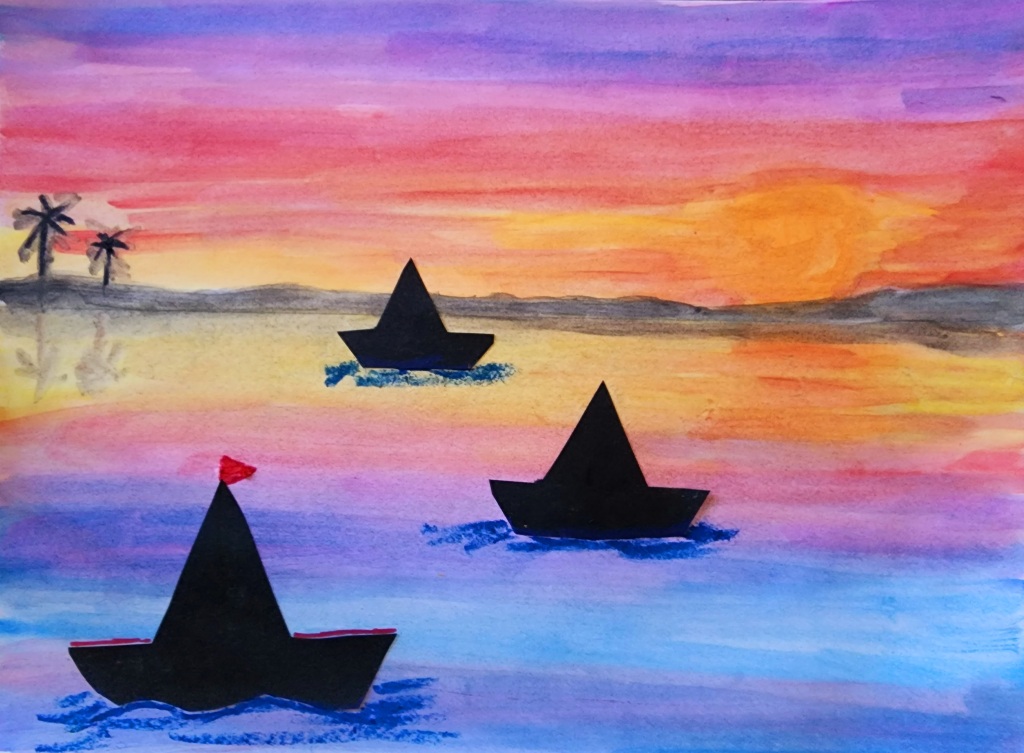
Another way to create a sense of space is the size of the object, the object that is further away from you is going to look smaller even if they are actually the same size!

Things Needed:

  1. Mixed media drawing paper.
  2. Black construction paper
  3. white crayon to draw on black paper
  4. ruler, scissors and gluestick
  5. watercolors

Steps to follow:

  1. On your black construction paper draw 2-3 sailboats. Make the sailboats different sizes. Keep in mind that you are going to stick these on your drawing paper. So don’t make them too large
  2. Next using your scissors cut out these boats and keep them aside.
  3. Now its time to paint the landscape. The first thing to do is to draw a horizon line separating the sky from the sea. I am going to paint a colorful sunset with my watercolors.
  4. Wait for the painting to dry. Next we are going to stick the sailboat cutouts on our paper.
  5. When sticking, the smallest boat is nearest to the horizon and as we go further from the horizon line and come closer to the bottom of the paper, the boats will look bigger, showing that they are closer to the viewer!
  6. Using a n oil pastel or crayon add some water lines under the sailboats. Your artwork is ready to be displayed!

If you would like to watch this lesson as a video please follow the link below:

The Overlap Project: Lesson 1 about Space Element of Art

Overlap is an important way to create an understanding of how space is created on a 2-dimensional art surface. Overlapping helps create an illusion of depth on a 2-dimensional surface. Overlap is the concept where you have an understanding that the object in the front will disrupt the view of an object that’s at the back or in other words the object at the back can hide behind the object at the front so that a part of the object is not visible.

In this project, we will create some fishes in the overlap. We will create 3-5 fishes on our art paper, making sure that at least one pair is in the overlap. We do this by making sure that 1 of the fish is hiding partly behind another fish. We will create a fish stencil using an index card or a 3×5 inch size card stock paper. Then we will use this stencil to create 3-5 fishes on drawing paper. We will create Line designs on these fishes using colorful oil pastels. Then we will paint the background or the negative space using watercolors.

Follow along step-by-step to make this Art Project.

Things Required:

  1. Drawing paper ( at least 8×10 inches Size)
  2. Card stock or index card 3×5 inches
  3. Scissors
  4. Black permanent marker
  5. Oil Pastels
  6. Watercolors

Steps to follow:

  • On the Index card draw the contour( Outline ) of a fish in such a way that it covers most of the paper. Check out the picture below to see how the drawing should look.
  • The next step is to carefully cut out the fish using your scissors. You have created your fish Stencil.
  • Use your Fish stencil and trace around on the drawing paper. You can place your fish anywhere you like. After drawing your first fish, draw the next fish in a way that part of it is hiding behind the first fish. This is called an overlap. Keep in mind that you do not need the trace the parts that will be hidden behind the first fish.
  • Keep adding more fish; make your composition interesting by making the fish going in different directions! You could also add a fish in a way that half of it is going out of your drawing paper!
  • Use a Black Permanent markerto outline your drawing. Then using Oil Pastels or crayons make some Colorful Patterns on your fishes. You can color the rest of the area using Watercolors

If you would like to watch this lesson as a video follow the link below: